

Normal Serum Selenium Levels

Dr. Margaret P. Rayman, Professor of Nutritional Science, University of Surrey at Guildford, said in 2002: ” Se deficiency is defined by Baum et al (1997)  as  a  plasma  level  ≤ 85μg/liter,  a  level  not  attained  in many northern European countries.”

Selenium is an important trace element that is needed for the proper functioning of our cells.  It is needed in very small amounts, but it might be a good idea to have a blood test done to check the serum selenium level. Selenium deficiency is associated with many health conditions.

The Mayo Clinic Laboratories state that the normal concentration in adult human blood serum is 70 to 150 micrograms per liter (the same as 70 to 150 nanograms per milliliter). According to the Mayo Clinic, the US population mean value is 98 micrograms per liter [Mayo Clinic].

Variations in Serum Selenium Levels

Diet, geographic location, demographic factors, and environmental factors all influence serum selenium levels.

The following factors are independent predictors of higher selenium status in the United States [Park]: read more
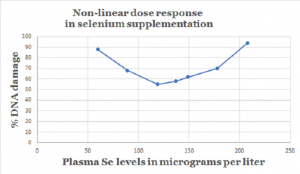
Serum/plasma selenium status and protection against cancer

In cancer prevention, there seems to be a U-shaped response to selenium supplementation. The threat of adversity is greater at the lower and higher levels of serum/plasma selenium. For example, Emily Chiang and her colleagues posit that the optimal serum selenium level for the reduction of prostate cancer risk is between 119 and 137 micrograms per liter. (Graph for illustration purposes only)

The documentation in various systematic reviews and meta-analyses of selenium and cancer studies shows a significant inverse association between selenium intake and/or plasma/serum selenium status and cancer [Lee; Hurst; Cai].

There is some evidence of a U-shaped relationship between plasma/serum selenium status and protection against cancer [Hurst; Rayman].  Low plasma/serum selenium status clearly correlates with higher risk of cancer.  High plasma/serum selenium status correlates with no increased protective effect against cancer.  The key is to find the supplement doses and subsequent plasma/serum status that give the best protection in between the two extremes.

Evaluating the evidence from published studies is complicated.  We need to remember that the following factors affect the relationship between selenium status and/or intake and cancer risk: read more