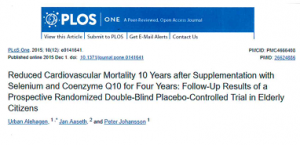
Adequate synthesis of several selenoproteins – including the various glutathione peroxidases and thioredoxin reductases and Selenoprotein P – is important for the anti-oxidative defense of the cells. Professor Urban Alehagen and a group of Swedish researchers observed significantly reduced death from heart disease in a 10-year follow-up of healthy elderly study participants who were given four years of combined high-selenium yeast and Coenzyme Q10 supplementation.
In a recent article on the web-site q10facts.com, I have posted a summary of an article in which researchers discuss the various ways in which statin medications may increase patients’ risk of atherosclerosis and heart failure. Yes, the Japanese and American researchers say, the statin medications do lower cholesterol levels [Okuyama].
But, the guidelines for the use of statin medications need to be re-examined. The researchers say: There has been a remarkable increase in the incidence of heart failure in the same period that statin medications have been used [Okuyama].
Furthermore, there are known mechanisms by which statin medications could be causing an increase in the incidence of atherosclerosis and heart failure.read more
Statin medications. What do we know? Yes, the statins are good at inhibiting the body’s own production of cholesterol. But the statins have the unintended side-effect of also inhibiting the body’s production of Coenzyme Q10 and of inhibiting the body’s ability to form selenoproteins. The inhibition of Coenzyme Q10 and selenoprotein production may lead to premature ageing and to degenerative diseases.
Statin medications: good news and bad news? On the one hand, statin medications are effective at reducing cholesterol levels, and, are good, apparently, at reducing the number of deaths from heart attacks. On the other hand, we have seen a very considerable rise in the number of cases of chronic heart failure … in the same period that statin medications have been prescribed. Drs. Okuyama and Langsjoen and their colleagues have explained the pharmacological mechanisms by which this medical paradox may be occurring [Okuyama].
Statins inhibit the body’s production of Coenzyme Q10 Okay, I was aware of the evidence from well-designed studies linking the taking of statin medications to decreased plasma levels of Coenzyme Q10. Coenzyme Q10 is an important factor in cellular energy production and is an important lipid-soluble antioxidant [Folkers, Littarru, McMurray]. And I knew that the energy-deprived heart is a failing heart [Folkers, Molyneux, Mortensen]. So, I knew that anyone taking a statin medication needs to talk to his or her cardiologist about taking a good Coenzyme Q10 supplement.read more
This website uses cookies to improve your experience. We'll assume you're ok with this, but you can opt-out if you wish. Cookie settingsACCEPT
Privacy & Cookies Policy
Privacy Overview
This website uses cookies to improve your experience while you navigate through the website. Out of these cookies, the cookies that are categorized as necessary are stored on your browser as they are essential for the working of basic functionalities of the website. We also use third-party cookies that help us analyze and understand how you use this website. These cookies will be stored in your browser only with your consent. You also have the option to opt-out of these cookies. But opting out of some of these cookies may have an effect on your browsing experience.
Necessary cookies are absolutely essential for the website to function properly. This category only includes cookies that ensures basic functionalities and security features of the website. These cookies do not store any personal information.
Any cookies that may not be particularly necessary for the website to function and is used specifically to collect user personal data via analytics, ads, other embedded contents are termed as non-necessary cookies. It is mandatory to procure user consent prior to running these cookies on your website.